|
CoMD
A Mini-app for Co-Design of Classical Molecular Dynamics.
|


|
|
CoMD
A Mini-app for Co-Design of Classical Molecular Dynamics.
|
|
Compute forces for the Embedded Atom Model (EAM). More...
#include "eam.h"#include <stdlib.h>#include <string.h>#include <math.h>#include <assert.h>#include "constants.h"#include "memUtils.h"#include "parallel.h"#include "linkCells.h"#include "CoMDTypes.h"#include "performanceTimers.h"#include "haloExchange.h"
Go to the source code of this file.
Data Structures | |
| struct | InterpolationObjectSt |
| Handles interpolation of tabular data. More... | |
| struct | EamPotentialSt |
| Derived struct for an EAM potential. More... | |
Macros | |
| #define | MAX(A, B) ((A) > (B) ? (A) : (B)) |
Typedefs | |
| typedef struct InterpolationObjectSt | InterpolationObject |
| Handles interpolation of tabular data. More... | |
| typedef struct EamPotentialSt | EamPotential |
| Derived struct for an EAM potential. More... | |
Functions | |
| static int | eamForce (SimFlat *s) |
| Calculate potential energy and forces for the EAM potential. More... | |
| static void | eamPrint (FILE *file, BasePotential *pot) |
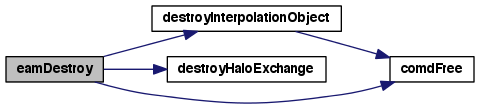
| static void | eamDestroy (BasePotential **pot) |
| static void | eamBcastPotential (EamPotential *pot) |
| Broadcasts an EamPotential from rank 0 to all other ranks. More... | |
| static InterpolationObject * | initInterpolationObject (int n, real_t x0, real_t dx, real_t *data) |
| Builds a structure to store interpolation data for a tabular function. More... | |
| static void | destroyInterpolationObject (InterpolationObject **table) |
| static void | interpolate (InterpolationObject *table, real_t r, real_t *f, real_t *df) |
| Interpolate a table to determine f(r) and its derivative f'(r). More... | |
| static void | bcastInterpolationObject (InterpolationObject **table) |
| Broadcasts an InterpolationObject from rank 0 to all other ranks. More... | |
| static void | printTableData (InterpolationObject *table, const char *fileName) |
| static void | eamReadSetfl (EamPotential *pot, const char *dir, const char *potName) |
| Reads potential data from a setfl file and populates corresponding members and InterpolationObjects in an EamPotential. More... | |
| static void | eamReadFuncfl (EamPotential *pot, const char *dir, const char *potName) |
| Reads potential data from a funcfl file and populates corresponding members and InterpolationObjects in an EamPotential. More... | |
| static void | fileNotFound (const char *callSite, const char *filename) |
| static void | notAlloyReady (const char *callSite) |
| static void | typeNotSupported (const char *callSite, const char *type) |
| BasePotential * | initEamPot (const char *dir, const char *file, const char *type) |
| Allocate and initialize the EAM potential data structure. More... | |
Compute forces for the Embedded Atom Model (EAM).
The Embedded Atom Model (EAM) is a widely used model of atomic interactions in simple metals.
http://en.wikipedia.org/wiki/Embedded_atom_model
In the EAM, the total potential energy is written as a sum of a pair potential and the embedding energy, F:
![\[ U = \sum_{ij} \varphi(r_{ij}) + \sum_i F({\bar\rho_i}) \]](form_0.png)
The pair potential  is a two-body inter-atomic potential, similar to the Lennard-Jones potential, and
  is interpreted as the energy required to embed an atom in an electron field with density
  . The local electon density at site i is calulated by summing the "effective
electron density" due to all neighbors of atom i:
. The local electon density at site i is calulated by summing the "effective
electron density" due to all neighbors of atom i:
![\[ \bar\rho_i = \sum_j \rho_j(r_{ij}) \]](form_4.png)
The force on atom i,  is given by
![\begin{eqnarray*} {\bf F}_i & = & -\nabla_i \sum_{jk} U(r_{jk})\\ & = & - \sum_j\left\{ \varphi'(r_{ij}) + [F'(\bar\rho_i) + F'(\bar\rho_j)]\rho'(r_{ij}) \right\} \hat{r}_{ij} \end{eqnarray*}](form_6.png)
where primes indicate the derivative of a function with respect to its argument and  is a unit vector in the direction from atom i to atom j.
The form of this force expression has two significant consequences. First, unlike with a simple pair potential, it is not possible to compute the potential energy and the forces on the atoms in a single loop over the pairs. The terms involving  cannot be calculated until
  is known, but calculating requires a loop over the pairs. Hence the EAM force routine contains three loops.
The second loop over pairs doubles the data motion requirement relative to a simple pair potential.
The second consequence of the force expression is that computing the forces on all atoms requires additional communication beyond the coordinates of all remote atoms within the cutoff distance. This is again because of the terms involving  . If atom j is a remote atom, the local task cannot compute
  . (Such a calculation would require all the neighbors of atom j, some of which can be up to 2 times the cutoff distance away from a local atom—outside the typical halo exchange range.)
To obtain the needed remote density we introduce a second halo exchange after loop number 2 to communicate for remote atoms. This provides the data we need to complete the third loop, but at the cost of introducing a communication operation in the middle of the force routine.
At least two alternate methods can be used to deal with the remote density problem. One possibility is to extend the halo exchange radius for the atom exchange to twice the potential cutoff distance. This is likely undesirable due to large increase in communication volume. The other possibility is to accumulate partial force terms on the tasks where they can be computed. In this method, tasks will compute force contributions for remote atoms, then communicate the partial forces at the end of the halo exchange. This method has the advantage that the communication is deffered until after the force loops, but the disadvantage that three times as much data needs to be set (three components of the force vector instead of a single scalar .
Definition in file eam.c.
| typedef struct EamPotentialSt EamPotential |
Derived struct for an EAM potential.
Uses table lookups for function evaluation. Polymorphic with BasePotential.
| typedef struct InterpolationObjectSt InterpolationObject |
Handles interpolation of tabular data.
|
static |
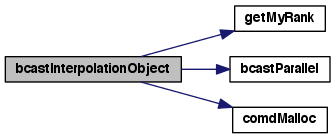
Broadcasts an InterpolationObject from rank 0 to all other ranks.
It is commonly the case that the data needed to create the interpolation table is available on only one task (for example, only one task has read the data from a file). Broadcasting the table eliminates the need to put broadcast code in multiple table readers.
Definition at line 544 of file eam.c.

|
static |
|
static |
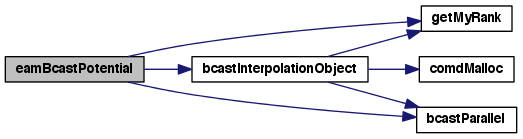
Broadcasts an EamPotential from rank 0 to all other ranks.
If the table coefficients are read from a file only rank 0 does the read. Hence we need to broadcast the potential to all other ranks.
Definition at line 407 of file eam.c.

|
static |
|
static |
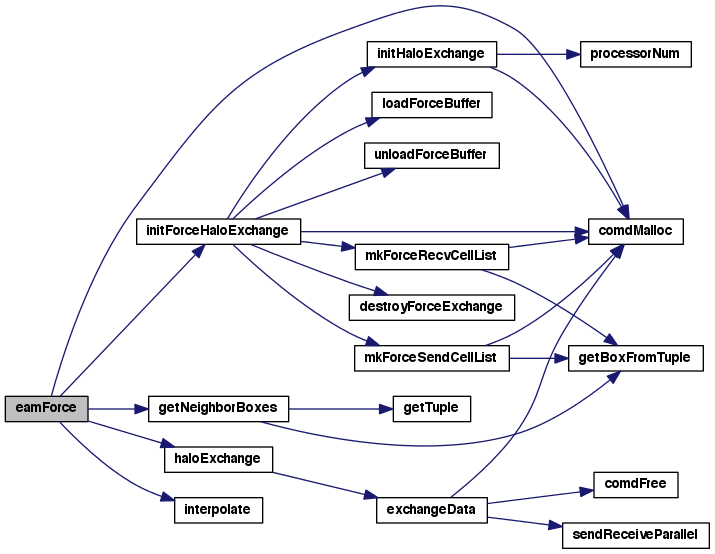
Calculate potential energy and forces for the EAM potential.
Three steps are required:
Definition at line 215 of file eam.c.

|
static |
|
static |
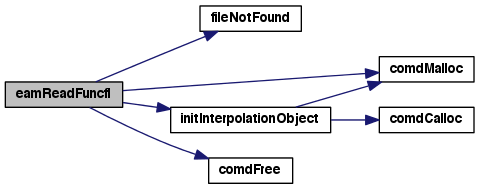
Reads potential data from a funcfl file and populates corresponding members and InterpolationObjects in an EamPotential.
funcfl is a file format for tabulated potential functions used by the original EAM code DYNAMO. A funcfl file contains an EAM potential for a single element.
The contents of a funcfl file are:
| Line Num | Description |
|---|---|
| 1 | comments |
| 2 | elem amass latConstant latType |
| 3 | nrho drho nr dr rcutoff |
| 4 | embedding function values F(rhobar) starting at rhobar=0 |
| ... | (nrho values. Multiple values per line allowed.) |
| x' | electrostatic interation Z(r) starting at r=0 |
| ... | (nr values. Multiple values per line allowed.) |
| y' | electron density values rho(r) starting at r=0 |
| ... | (nr values. Multiple values per line allowed.) |
Where:
funcfl format stores the "electrostatic interation" Z(r). This needs to be converted to the pair potential phi(r). using the formula
![\[phi = Z(r) * Z(r) / r\]](form_14.png)
NB: phi is not defined for r = 0
Z(r) is in atomic units (i.e., sqrt[Hartree * bohr]) so it is necesary to convert to eV.
F(rhobar) is in eV.
Definition at line 752 of file eam.c.

|
static |
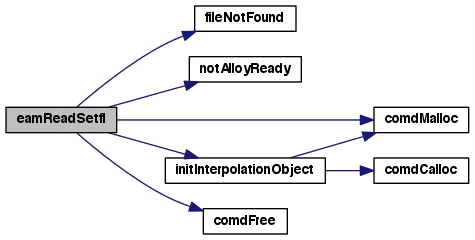
Reads potential data from a setfl file and populates corresponding members and InterpolationObjects in an EamPotential.
setfl is a file format for tabulated potential functions used by the original EAM code DYNAMO. A setfl file contains EAM potentials for multiple elements.
The contents of a setfl file are:
| Line Num | Description |
|---|---|
| 1 - 3 | comments |
| 4 | ntypes type1 type2 ... typen |
| 5 | nrho drho nr dr rcutoff |
| F, rho | Following line 5 there is a block for each atom type with F, and rho. |
| b1 | ielem(i) amass(i) latConst(i) latType(i) |
| b2 | embedding function values F(rhobar) starting at rhobar=0 |
| ... | (nrho values. Multiple values per line allowed.) |
| bn | electron density, starting at r=0 |
| ... | (nr values. Multiple values per line allowed.) |
| repeat | Return to b1 for each atom type. |
| phi | phi_ij for (1,1), (2,1), (2,2), (3,1), (3,2), (3,3), (4,1), ..., |
| p1 | pair potential between type i and type j, starting at r=0 |
| ... | (nr values. Multiple values per line allowed.) |
| repeat | Return to p1 for each phi_ij |
Where:
setfl format stores r*phi(r), so we need to converted to the pair potential phi(r). In the file, phi(r)*r is in eV*Angstroms. NB: phi is not defined for r = 0
F(rhobar) is in eV.
Definition at line 634 of file eam.c.

|
static |
|
read |
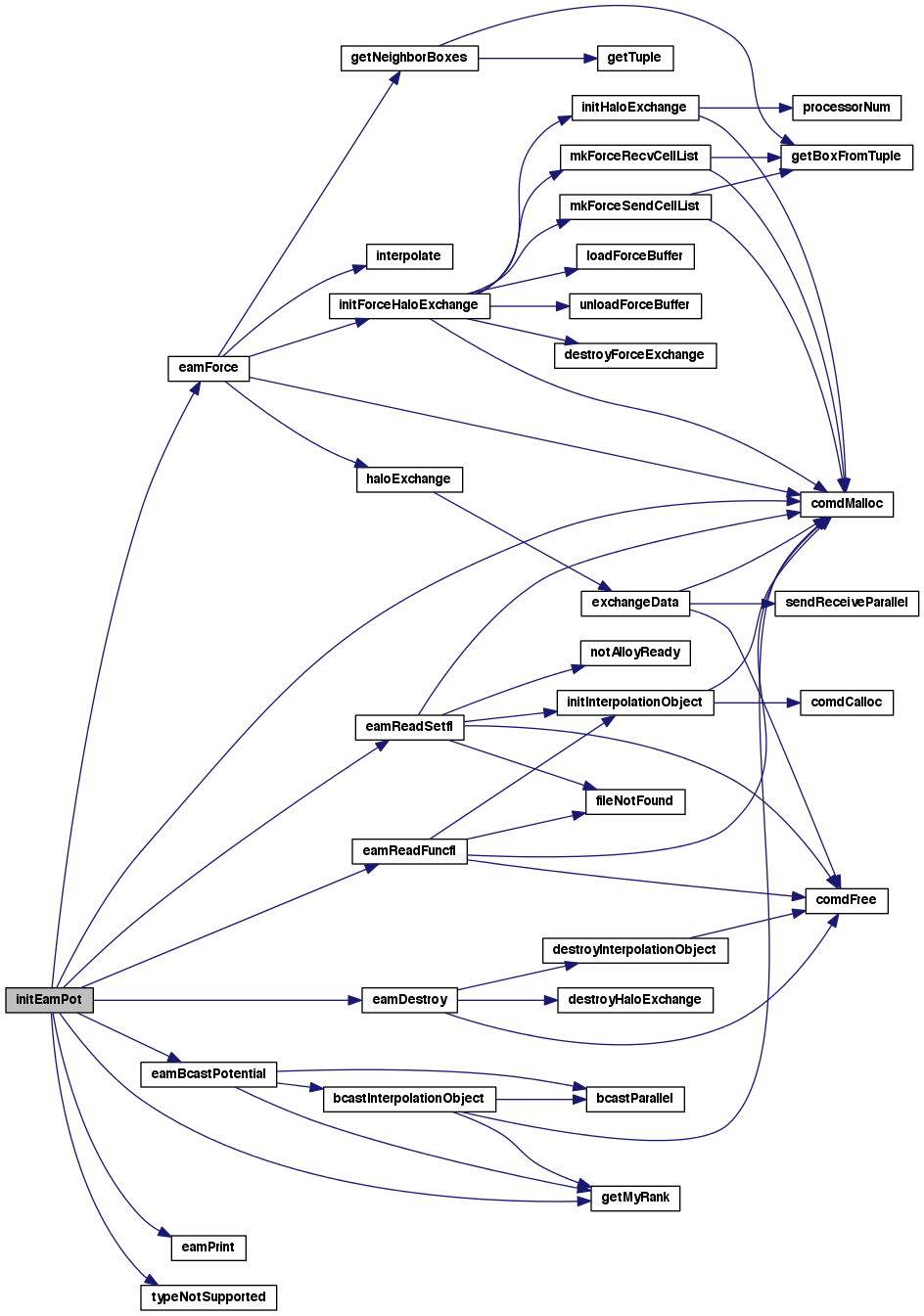
Allocate and initialize the EAM potential data structure.
| [in] | dir | The directory in which potential table files are found. |
| [in] | file | The name of the potential table file. |
| [in] | type | The file format of the potential file (setfl or funcfl). |
Definition at line 171 of file eam.c.

|
static |
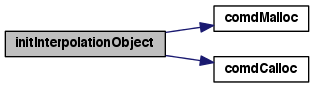
Builds a structure to store interpolation data for a tabular function.
Interpolation must be supported on the range ![$[x_0, x_n]$](form_12.png) , where
, where  .
.
| [in] | n | number of values in the table. |
| [in] | x0 | minimum ordinate value of the table. |
| [in] | dx | spacing of the ordinate values. |
| [in] | data | abscissa values. An array of size n. |
Definition at line 452 of file eam.c.

|
static |
Interpolate a table to determine f(r) and its derivative f'(r).
The forces on the particle are much more sensitive to the derivative of the potential than on the potential itself. It is therefore absolutely essential that the interpolated derivatives are smooth and continuous. This function uses simple quadratic interpolation to find f(r). Since quadric interpolants don't have smooth derivatives, f'(r) is computed using a 4 point finite difference stencil.
Interpolation is used heavily by the EAM force routine so this function is a potential performance hot spot. Feel free to reimplement this function (and initInterpolationObject if necessay) with any higher performing implementation of interpolation, as long as the alternate implmentation that has the required smoothness properties. Cubic splines are one common alternate choice.
| [in] | table | Interpolation table. |
| [in] | r | Point where function value is needed. |
| [out] | f | The interpolated value of f(r). |
| [out] | df | The interpolated value of df(r)/dr. |
Definition at line 512 of file eam.c.

|
static |
|
static |
 1.8.3.1